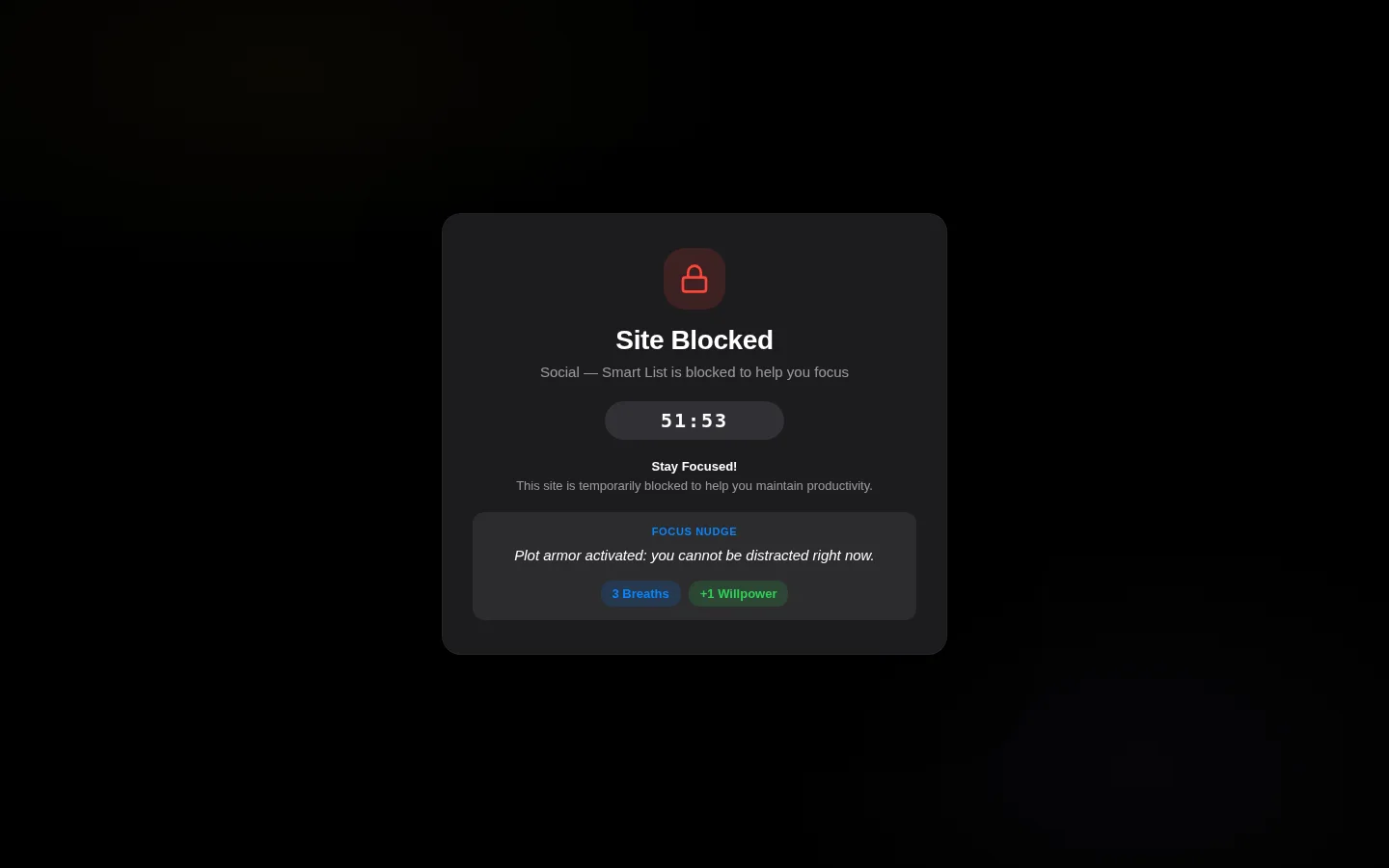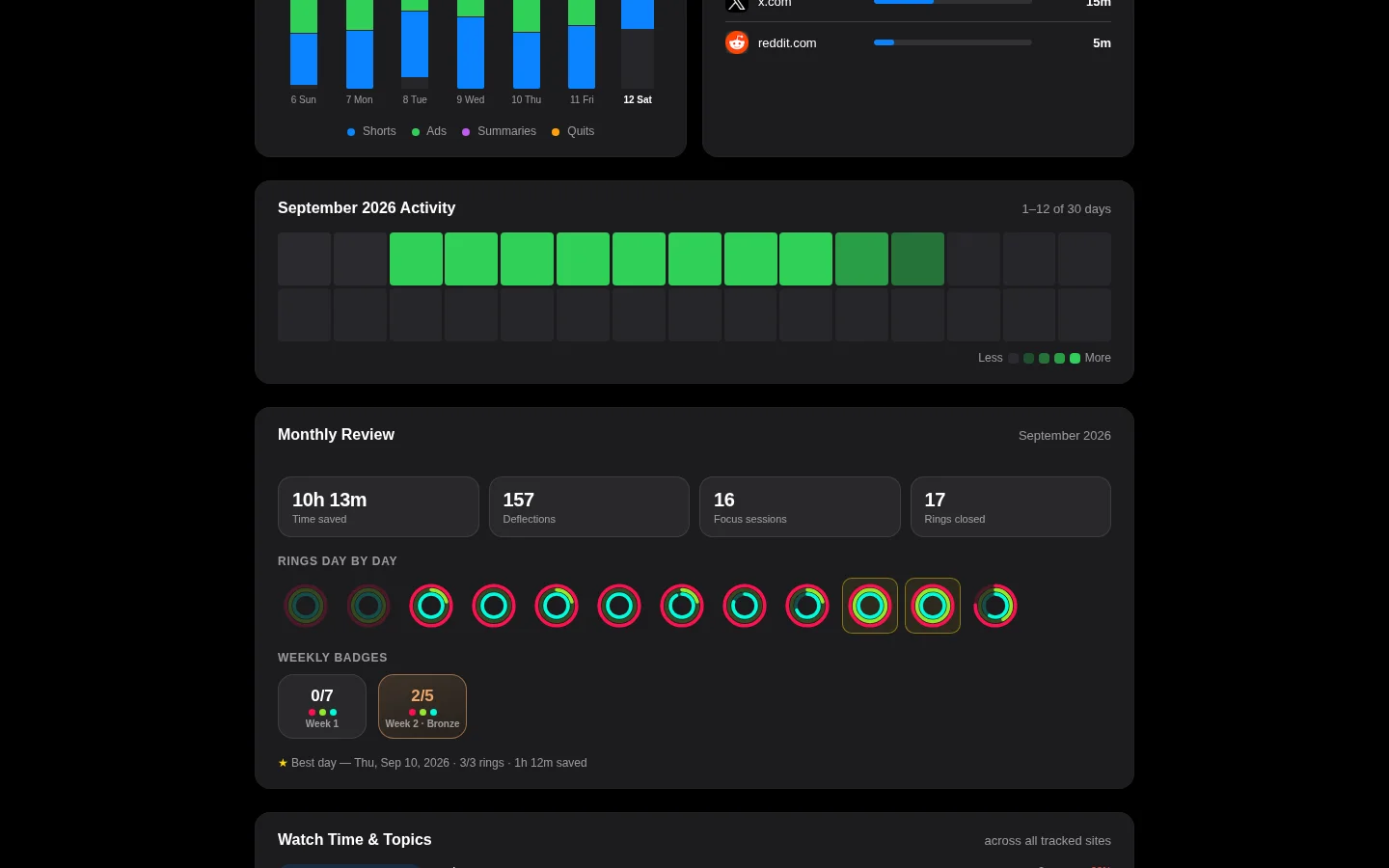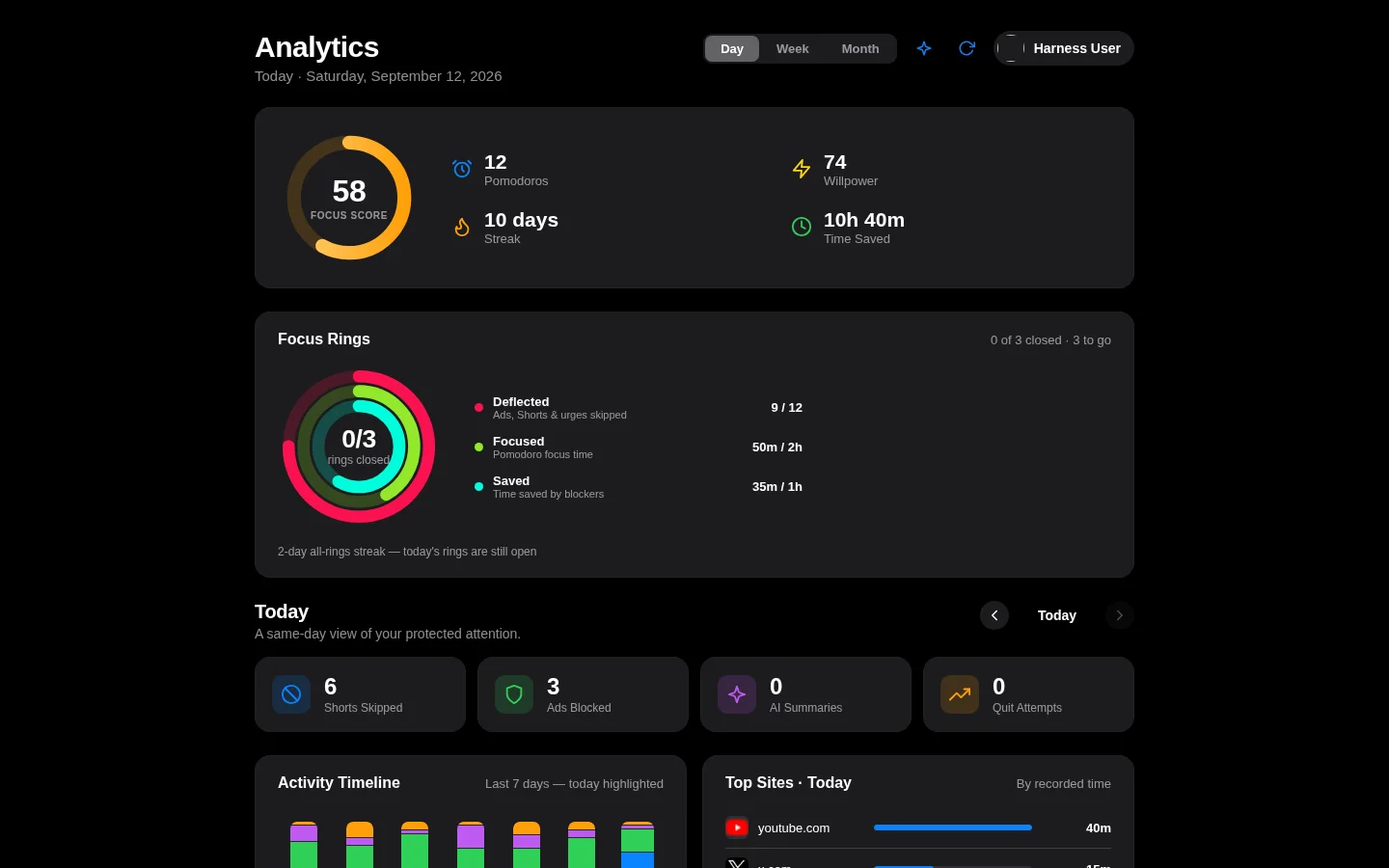
Apple Fitness solved something subtle: it made invisible effort visible without shaming the invisible days. We spent a year adapting that idea from steps and calories to deflections and saved minutes.
Why rings, of all things
Activity rings work because they resolve a paradox: a habit tracker must be visible enough to motivate, but forgiving enough not to punish the days motivation fails. Rings do this with two properties. They're closed, not filled — a partial day looks like a circle waiting to complete, not a bar that failed to reach the top. And they reset daily, which means every morning is a fresh start rather than a continuation of yesterday's debt.
When we designed Focus Rings, the question was what the attention equivalents of "move" and "exercise" even are. Steps don't translate. Minutes-watched certainly don't — that's YouTube's metric. The answer came from watching what protection actually produces.
Deflected, Focused, Saved
The triple ring maps to the three things a protection tool makes possible. Deflected counts ads, Shorts and urges skipped — the temptations that never became sessions. Focused counts Pomodoro minutes — time you deliberately spent. Saved counts the minutes blockers returned to you — time that would statistically have been lost.
The elegant property of this triple is that every ring measures a positive act. There is no "time wasted" ring, because FocusTube refuses to grade your leisure. The rings only ever celebrate protection and intention — the system stays on your side even when the day goes sideways.
Goals you set, goals you keep
Research on goal-setting is blunt: self-set goals outperform assigned ones. So ring goals are editable in Settings, and v1.17's Adaptive Goals makes the system a advisor rather than a boss — Monday's briefing compares your 4-week trend against each goal and suggests one calibration step up or down. You apply it or keep yours. The software never moves the target without permission.
That last part matters more than it sounds. Plenty of habit apps quietly raise goals to manufacture engagement — the streak becomes a leash. If a habit system works, its user should be able to point at the goal and say "I chose that."
Streaks that can be rained on
Classic streaks are fragile and slightly dishonest: miss one day and the counter zeroes, as if three good weeks never happened. FocusTube's Streak Insurance treats streaks like real routines. Close all rings on four or more days in a week and the next week banks a freeze — one missed day, absorbed, marked with a shield. Miss without a freeze and the chain can still be repaired by doubling your Focused goal the next day.
Crucially, the whole ledger is derived from your history rather than stored as a mutable counter. It can't drift, and it can't be forged — which matters once rings become something you might actually be proud of.
Celebration without confetti spam
Closing all three rings triggers a celebration — sparks, a glow, the little award. It plays exactly once per day, it's earned by 3/3 rather than by opening the app, and it is fully disabled under prefers-reduced-motion. Celebration in a calm tool should feel like a pat on the back, not a casino payout. The restraint is the point: the reward for closing rings is the closed rings, and everything else is just applause.